

How Prop Firm Challenges Work: Rules & Evaluation Process
A prop firm challenge is the evaluation process a trader goes through to unlock a funded account. Every prop firm uses some form of evaluation, either a classic multi-phase challenge or an instant funding model with stricter ongoing rules. The logic behind it is simple: a prop firm gives access to significant trading capital, sometimes hundreds of thousands of dollars, and before handing over that capital it wants to see the trader can hit a profit target without blowing the account. The challenge fee is also the firm's main source of revenue in most business models, so the evaluation is both a filter and a profit center. A lot of traders treat the challenge as a one-time obstacle to clear, but in practice the rules of the evaluation usually carry over almost unchanged into the funded stage, so learning to trade within those rules during the challenge is the same skill you need later. In this article we explain how challenges work step by step, what formats exist, how profit targets and drawdowns are calculated, where most applicants fail and how to pick a challenge that fits your strategy.
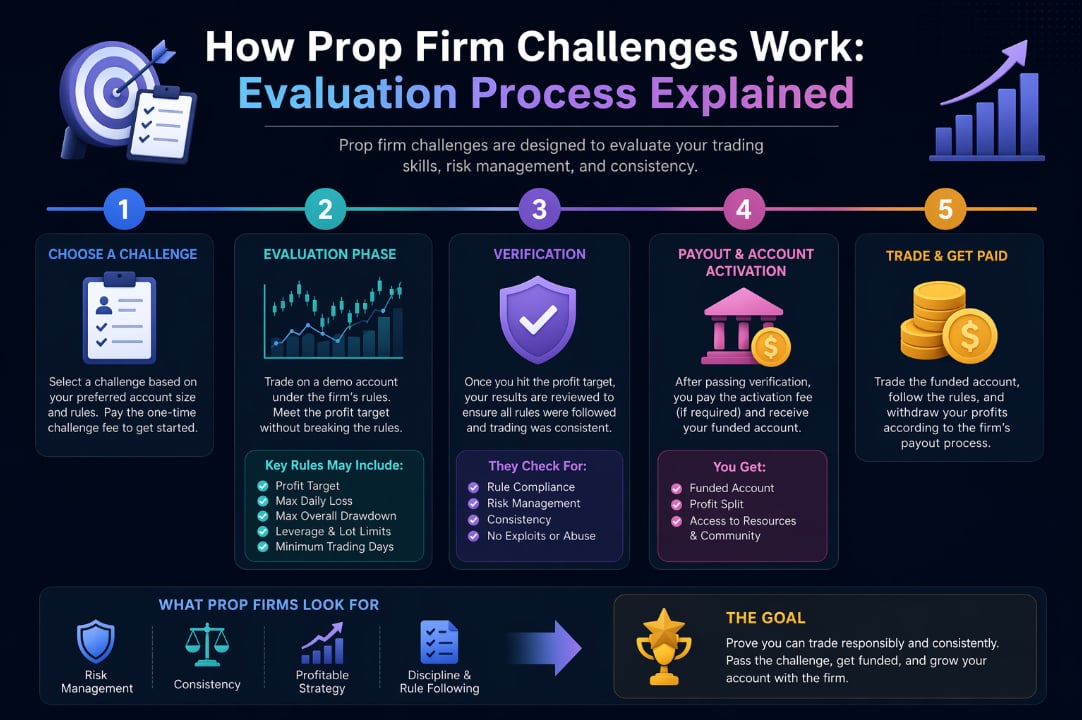
Purpose of evaluation
An evaluation challenge serves two goals for the firm. First, it filters out losing traders and reduces the chance of paying out capital to someone who won't maintain discipline. Second, it generates revenue: with pass rates estimated at 10-15% across the industry, challenge fees from failed applicants fund payouts to successful ones and cover the firm's operating costs. From the trader's side, the challenge is a paid audition where the cost is the fee and the prize is access to a funded account worth 50-200 times the fee, sometimes more. Unlike hiring a trader at a traditional trading desk, where the firm screens by interview, résumé and track record, a prop firm challenge screens purely by performance under rules, which makes the process open to anyone with a small budget and a working strategy.
Challenge formats
The most common format is the two-step challenge: phase 1 with a higher profit target (usually 8-10%), phase 2 with a lower target (4-5%), both under the same drawdown rules. Phase 1 is designed to prove the trader can generate profit, phase 2 is designed to prove the result wasn't a one-off. Some firms offer one-step evaluations with a single profit target (typically 8-10%) but stricter risk rules, which suits experienced traders who prefer speed over the extra safety margin of a two-phase format. A small number of firms run three-step challenges, usually for larger accounts or as a premium verification layer on top of a standard two-step. Instant funding is the opposite end of the spectrum: no challenge at all, a higher upfront fee and a funded account straight away, but with tighter drawdown (commonly 3-5% instead of 8-10%) and usually a lower profit split until certain milestones are hit.
In a nutshell, shorter challenges mean stricter ongoing rules, longer challenges mean more phases to clear. There is no objectively best format — the right choice depends on the trader's experience, strategy and willingness to trade under tight real-time drawdown limits.
Profit targets
A profit target is a percentage of the starting account balance the trader needs to reach to clear a phase. For a $100k account with an 8% phase 1 target, the trader needs to generate $8k in profit before moving on. How the target is measured matters a lot: some firms count only closed profit (the balance on the account after all trades are closed), others accept equity high (counting unrealized profit on open positions). The distinction is important for swing traders, who often hold positions through temporary drawdowns — if only closed profit counts, a floating profit of 10% is irrelevant until the position is closed.
Most firms don't set a maximum profit target, so the trader can keep trading above the required level to build a buffer against the overall drawdown. On a plus side, extra profit during evaluation reduces the chance of a subsequent breach. On a minus side, chasing profit beyond the target often leads to over-trading and a blown account just before passing. Another benefit of hitting the target conservatively and stopping early is the shortened time to the funded stage, especially under unlimited evaluation periods where the trader can submit for review at any point after meeting the minimum trading days.
Time limits and trading days
Time limits have changed a lot in the last few years. The traditional model was 30 calendar days for phase 1 and 60 for phase 2, with the clock running whether the trader opened trades or not. A lot of firms have since moved to unlimited evaluation periods, where the challenge doesn't expire and the trader can take as long as he needs to hit the target. Unlimited periods are easier to market and reduce the pressure that drives over-trading, but firms usually offset the change by tightening other rules, such as drawdown calculations or consistency requirements.
Minimum trading days is the other side of the time requirement. Most firms require 5 trading days minimum (some 3, some 10), a trading day defined as a day with at least one position open. The idea is the same as consistency rules: to prevent passing on a single lucky trade. Maximum trading day limits still exist at a handful of firms but have largely disappeared under the unlimited-time model.
Drawdown during evaluation
Drawdown limits during the challenge are typically the same as during the funded stage, which makes the evaluation a realistic rehearsal of live trading conditions. Daily drawdown is usually set at 4-5% and resets every trading day at the broker's server time (most firms use 5 PM EST or 0:00 GMT as the reset point). Overall drawdown is 8-12% on most standard accounts, measured from either the initial balance (static) or the highest reached equity/balance (trailing).
The calculation base is where traders lose challenges without understanding why. With static drawdown, the limit is fixed from day one and never changes, so profit creates a growing buffer. With trailing drawdown, the limit moves up with every new equity high until it reaches the initial balance, at which point it usually locks. For example, on a $100k account with 10% trailing drawdown, hitting $105k equity moves the drawdown line to $95k, even if the trader closes the position below the peak. A lot of applicants pass phase 1 and fail phase 2 not because of an outright loss, but because they give back unrealized profit after a strong day.
Consistency rule during challenges
Consistency rules are one of the most overlooked parts of modern challenges. Some firms apply the rule only on funded accounts, others apply it during the evaluation itself. The typical form: no single trading day can represent more than 30-50% of the total profit generated during the phase. For example, with a 40% consistency rule and $10k of total phase profit, no single day can contribute more than $4k. A trader who hits the target on one large trade may still fail the phase because of this rule, even with clearly positive P&L. The way to manage consistency is to build profit over multiple sessions and avoid loading up on a single setup, which aligns with the firm's preference for steady traders over lucky ones.
Rule restrictions during the challenge
Beyond profit targets and drawdowns, a prop firm challenge enforces the same trading rules as the funded stage at most firms. Common restrictions include news trading bans with a 2-5 minute buffer around high-impact releases (such as NFP, CPI or FOMC), weekend holding bans or limits, EA and HFT bot restrictions, maximum lot size per trade, and hedging or grid trading restrictions. These apply from the first trade of the challenge. Some firms relax rules after funding, for example by allowing weekend holding with separate permission, but this is rare — most keep rules identical across the evaluation and funded stages. Before starting any challenge, it is important to read the full rules document, not just the summary on the landing page, because a strategy allowed at one firm can get the account terminated at another.
Common reasons traders fail
The 10-15% industry pass rate is not about market difficulty — most applicants fail for reasons related to the rules rather than to market moves. The typical failure patterns are:
Over-leveraging early to hit the target fast, then breaching daily drawdown after one bad trade
Revenge trading after an unexpected loss
Misreading drawdown type, especially trailing drawdown after a strong initial session
Accidentally trading through a news release because of wrong buffer calculation
Missing the minimum trading days requirement despite hitting the profit target
Violating the consistency rule on an outsized profitable day
Leaving a position open over the weekend at a firm that forbids it
Running an EA or automated script that violates the firm's automation rules
Most of these are rule-reading and discipline issues rather than strategy problems, which is why the same trader often fails multiple challenges with the same pattern before adjusting.
Reset options
Most firms offer a reset option — pay a reduced fee (typically 50-70% of the original challenge price), keep the account at the same size and restart the phase from zero. Some packages include one free reset as a marketing feature. On a plus side, a reset is cheaper than buying a new challenge and preserves any existing progress in the firm's internal systems, such as trader scorecards or loyalty credits. On a minus side, the reason the trader failed the first time usually doesn't disappear on the second attempt, so paying for reset after reset without changing behavior is a common way to lose more money than a single new challenge would have cost.
From pass to funded account
Passing the final phase triggers the transition to the funded stage. The typical process is: the trader submits the account for review, the firm's compliance team checks trading records (for potential rule violations, shared IP addresses with other accounts, reverse copy trading between challenges, etc.), then the trader signs a trader agreement and completes KYC. Processing time ranges from 1-3 business days at established firms to a week or more at smaller operations. The funded account usually opens at the same size as the evaluation, with identical drawdown rules and the same trading platform. The first payout is typically available after 7-14 days of trading on the funded account, provided the trader generated profit and met minimum trading days. From this point the evaluation process is complete and the trader can focus on long-term performance, payouts and scaling.
How to pick the right challenge
With hundreds of firms on the market, picking a challenge is mostly a matching exercise between the firm's rules and the trader's strategy. Swing traders should avoid firms with strict weekend holding rules and prefer static drawdown over trailing. Scalpers should check news buffer rules, maximum trades per day and commission structure — high commissions can destroy a high-frequency strategy. News traders should look specifically for firms with no news buffer, which exist but are a small minority. Beginners benefit most from two-step challenges with unlimited time and static drawdown, which give room to learn without running out of days.
Beyond strategy fit, three other factors matter: payout reliability (the single most important check, with community reviews and recent payout proofs as the best sources), broker and platform quality (MT4, MT5, cTrader or proprietary, each suiting different styles) and price relative to competitors for the same account size and rules. The cheapest challenge is rarely the best value if the firm's payout process is broken or its drawdown rules are unusually strict. It is important to approach challenge selection as a multi-factor decision rather than chasing the lowest fee or the highest advertised account, isn't it?
Where to go next
About Marina G.
Professional content writer specializing in prop trading and financial markets.
Related Articles
More insights from our prop trading experts