

What is a prop trading firm and how does it work
A prop trading firm, or proprietary trading firm, is a company that funds traders with firm's capital in exchange for a share of the profits. Unlike a regular broker that makes money on spreads and commissions from client activity, a prop firm takes on the risk and splits the upside with the trader. The trader doesn't deposit his own money into a live account — instead he proves his skill through an evaluation challenge, and once passed, gets access to a funded account from the firm. A lot of traders prefer prop firms because this model lets them trade larger size than they could afford personally, without risking personal savings beyond the one-time challenge fee. The business has grown rapidly since 2020 and today you can find hundreds of prop firms online, from established names backed by real trading desks to small online operations built around challenge sales. Because this market is new and largely unregulated, the terms, rules and payout reliability differ a lot between firms, which makes careful comparison of conditions crucial before committing to any challenge.
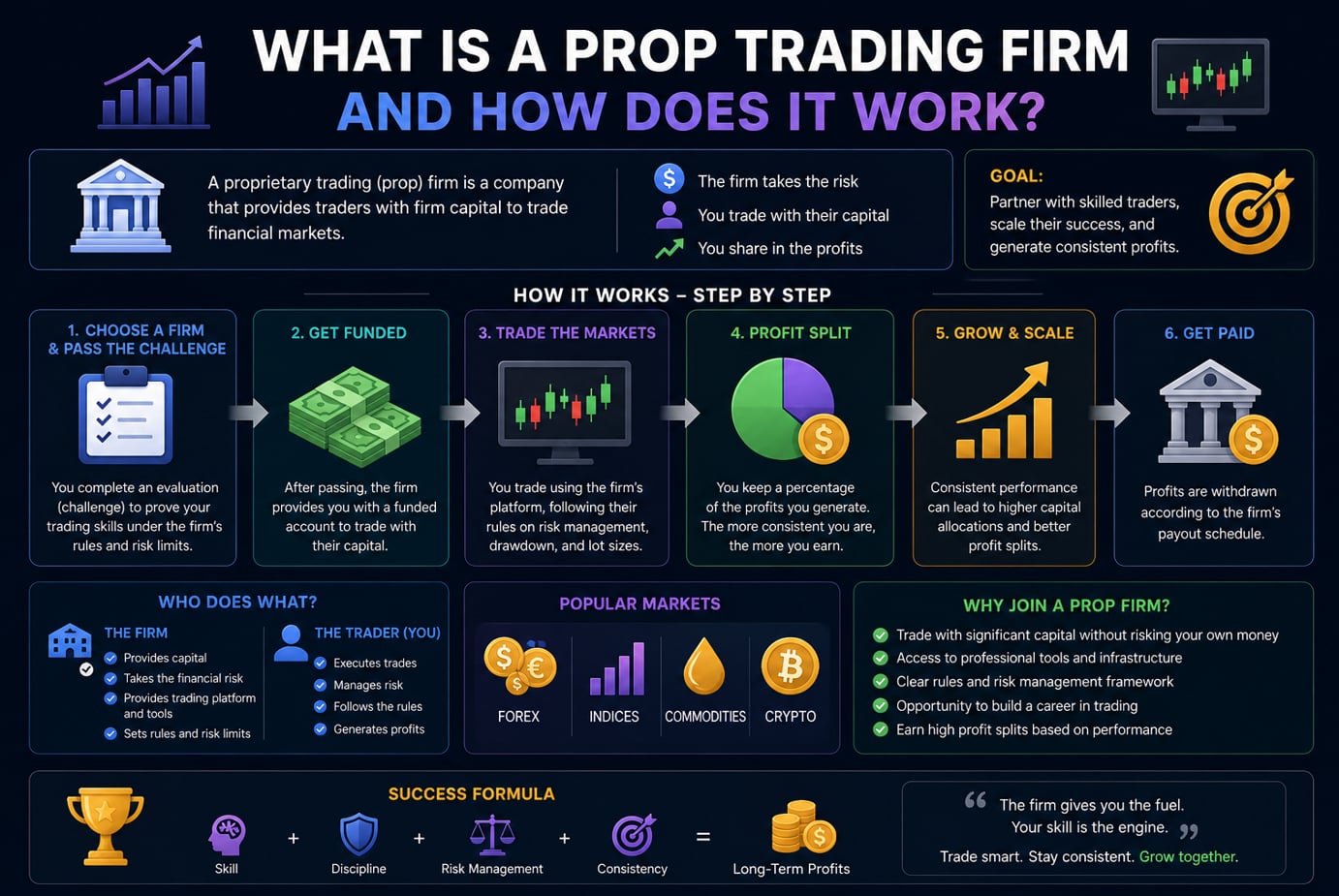
How prop firms work
The typical prop firm model works in three stages: evaluation, funded account and scaling. First, the trader pays a one-time fee and enters an evaluation challenge, where he trades a demo account with specific profit targets and strict risk rules. If he hits the target without breaching drawdown limits, he moves on to a funded stage. The funded account can be a real capital account or a larger demo account where the firm pays the trader real money based on simulated results — both structures exist in the industry. After the trader generates profit on a funded account, he requests a payout and receives his share, which usually ranges from 70% to 90% of net profit. The rest stays with the firm and covers its operating costs, challenge refunds and payouts to other successful traders. Most reputable firms also refund the initial challenge fee with the first payout, so a consistent trader effectively keeps 100% of his upfront cost.
In a nutshell, a prop firm acts as a capital provider and a rule-setter at the same time. The trader brings skill, the firm brings money and infrastructure, and profits are split according to the agreement. On a plus side, this structure lets skilled traders scale much faster than they could with personal capital. On a minus side, the rules are strict and one bad day may cost the entire account.
Challenge and evaluation
An evaluation challenge is the entry gate for almost every prop firm. The classic format is a two-step challenge: phase 1 requires 8-10% profit within a set time, phase 2 requires a lower 4-5% target under the same drawdown rules. Some firms offer one-step evaluations, instant funding with no challenge at all (usually at a higher fee), or extended three-step models for larger accounts. Time limits were traditionally 30 days for phase 1 and 60 for phase 2, but a lot of firms have since switched to unlimited evaluation periods, where the trader can take as long as he needs to hit the target. Challenge fees depend on the account size and typically range from $50 for a $10k account to $500-$1000 for a $200k account. Larger accounts, up to $400k or even $600k at some firms, come with proportionally higher fees.
The evaluation stage is where most applicants fail, with pass rates generally estimated at 10-15% across the industry. The main reasons are aggressive position sizing, over-trading around news releases and emotional decisions after a losing streak. Because the challenge is paid, failure means loss of the fee, which is the firm's primary source of revenue in most business models.
Drawdown rules
Drawdown is probably the most important parameter of any prop challenge and the one where firms differ the most. There are two drawdown limits on almost every account: daily drawdown and overall (or maximum) drawdown. Daily drawdown is typically set at 4-5% and resets every trading day, overall drawdown at 8-12% and is cumulative through the entire account lifecycle. Breaching either limit terminates the account immediately, regardless of the trader's current profit or balance.
Overall drawdown comes in two flavors that are easy to confuse: static and trailing. Static drawdown stays fixed at the initial threshold for the whole lifetime of the account, so once a trader is in solid profit his effective risk buffer keeps growing. Trailing drawdown moves up with account equity (or balance, depending on the firm) until it reaches the initial deposit level, at which point it usually locks. For example, with a $100k account and 10% trailing drawdown, if the trader grows the account to $105k, the drawdown line moves up to $95k. Trailing drawdown is significantly stricter and a lot of traders lose accounts not because they had a big loss, but because they gave back a chunk of unrealized profit after hitting a peak.
Profit split and payout
Profit split is the share of profit the trader keeps after a payout request. The industry standard is 80/20 in the trader's favor, but you can find firms offering anywhere from 70% to 90% as a default, with many running add-ons that push the split to 95% or 100% for a premium fee. The split is usually fixed for the first funded stage and grows with scaling, for example from 80% on the starting level to 90% after reaching the top scaling tier.
Payout frequency is another key parameter. Most firms process payouts every 14 or 30 days, some allow on-demand payouts after the first one, and a handful offer bi-weekly or even weekly cycles for established traders. The first payout is often gated behind additional conditions, such as a minimum holding period (typically 7-14 days), minimum number of trading days (usually 5-10) and sometimes a minimum profit threshold before the request can be submitted. Payout methods vary from standard bank transfers and PayPal to crypto transfers in stablecoins, which have become dominant in the last two years because of faster settlement. It is important to check payout reliability before joining any firm, as this is the single most common complaint in prop trading communities and the area where weaker firms fail first.
Scaling plans
Scaling is how a trader grows his account size over time without paying for a new challenge. A typical scaling plan doubles the account after the trader generates 8-10% profit within a set number of consecutive months (usually 3-4) without violating any rules. Some firms increase the size by 25-40% per step instead of doubling, but reach the same final cap over a longer path. Top tiers vary a lot: some firms cap scaling at $400k, others go up to $2 million or more, with a few advertising no hard cap at all for consistent performers.
On a plus side, scaling gives a disciplined trader a path to serious capital without ever risking his own money beyond the original fee. On a minus side, scaling conditions are often tighter than they sound: the consistency requirement, the monthly cadence and the no-rule-breach clause together make steady scaling harder than a single profitable streak. Another benefit of good scaling programs is that they usually come with an improved profit split at higher tiers, which multiplies the effect of account growth.
Trading rules and restrictions
Beyond drawdown, prop firms apply a range of trading rules that limit what and how the trader can trade. The most common restrictions are:
News trading — a lot of firms prohibit opening or closing trades within 2-5 minutes of high-impact news releases, such as NFP, CPI, FOMC or central bank rate decisions
Weekend holding — holding positions over the weekend is banned by many firms or allowed with additional restrictions
EA and copy trading — fully automated strategies, HFT bots, martingale systems and tick scalpers are commonly forbidden; manual copy trading between a trader's own accounts is usually allowed, copying from other traders' accounts is not
Consistency rule — the firm requires that no single trading day represents more than a set percentage (often 30-50%) of total profit, to prevent traders from passing challenges on a single lucky trade
Lot size limit — maximum position size per trade or per symbol
Hedging and grid trading — often restricted on the same account, sometimes allowed with specific exceptions
These rules differ a lot between firms and are the main reason why a strategy that works perfectly at one prop firm can get an account terminated at another. Before paying for any challenge, it is important to read the full rulebook, not just the headline numbers on the landing page.
Prop firm vs personal trading account
Unlike a personal brokerage account, a prop firm account comes with external rules and external capital, but also with built-in risk management. On a personal account the trader uses his own money, takes 100% of the profit and 100% of the loss, and no-one can close his position except himself. On a prop account the trader uses firm's capital, takes a share of the profit and nothing of the loss beyond the challenge fee, but is bound by strict rules and can lose the account over a single rule breach.
For traders with small personal capital, a prop firm is often the only realistic path to trading $50k-$200k size without taking years to grow an account organically. For traders with significant personal funds, the attraction is the asymmetric risk profile: a $500 challenge fee in exchange for a chance at a $100k account is a bet a lot of traders are willing to take. On the other hand, for traders who already have reliable profitable strategies on their own capital and no interest in external rules, a prop firm adds constraints with limited upside.
Advantages of prop trading
Access to significant trading capital without personal deposits
Limited downside, where the worst case is the loss of the challenge fee
No direct client money risk, which can reduce emotional pressure
Scaling path that rewards consistency over time
Profit split that can reach 90% or higher on top tiers
Structured environment that forces discipline in position sizing and risk
Disadvantages of prop trading
Rules are strict and one violation terminates the account
Evaluation fees add up if a trader retries multiple times
Simulated funded accounts depend fully on firm's solvency for payouts
Industry is largely unregulated and fly-by-night firms are common
Profit split reduces net return compared to trading personal capital
Restrictions on news trading, EAs and weekend holding may not fit every strategy
Who prop trading suits and who it doesn't
Prop trading suits disciplined traders with a tested strategy and solid risk management, who want to trade larger size than their personal account allows. It works especially well for swing and intraday traders with controlled drawdown and steady monthly returns in the 3-8% range. For scalpers, news traders and EA-heavy strategies the picture is mixed — some firms are specifically built for these styles, others exclude them entirely, so choice of firm matters more than the choice to join prop trading in general.
On the other hand, prop trading is a poor fit for traders who haven't yet developed a repeatable strategy, traders with a gambling or revenge-trading tendency and those who need immediate income from trading. The challenge-first model means zero income until evaluation is passed and first payout is processed, which typically takes at least 2-3 months even for skilled applicants. Given the high failure rate on evaluations and the cost of repeated attempts, it is important to approach prop trading as a long-term career step rather than a quick income fix, isn't it?
About Marina G.
Professional content writer specializing in prop trading and financial markets.
Related Articles
More insights from our prop trading experts

