

How to choose your first prop firm: 7 factors that matter
There are hundreds of prop firms competing for the same pool of traders, and most of their landing pages say roughly the same thing: fast payouts, generous splits, achievable targets. None of that helps when you're actually trying to pick one. The honest problem isn't a shortage of information — it's that the information that matters (payout reliability, actual rule enforcement, how drawdown really gets calculated) rarely shows up on the page selling you the challenge. It shows up in trader forums, in the fine print, and sometimes only after you've already paid the fee and started trading.
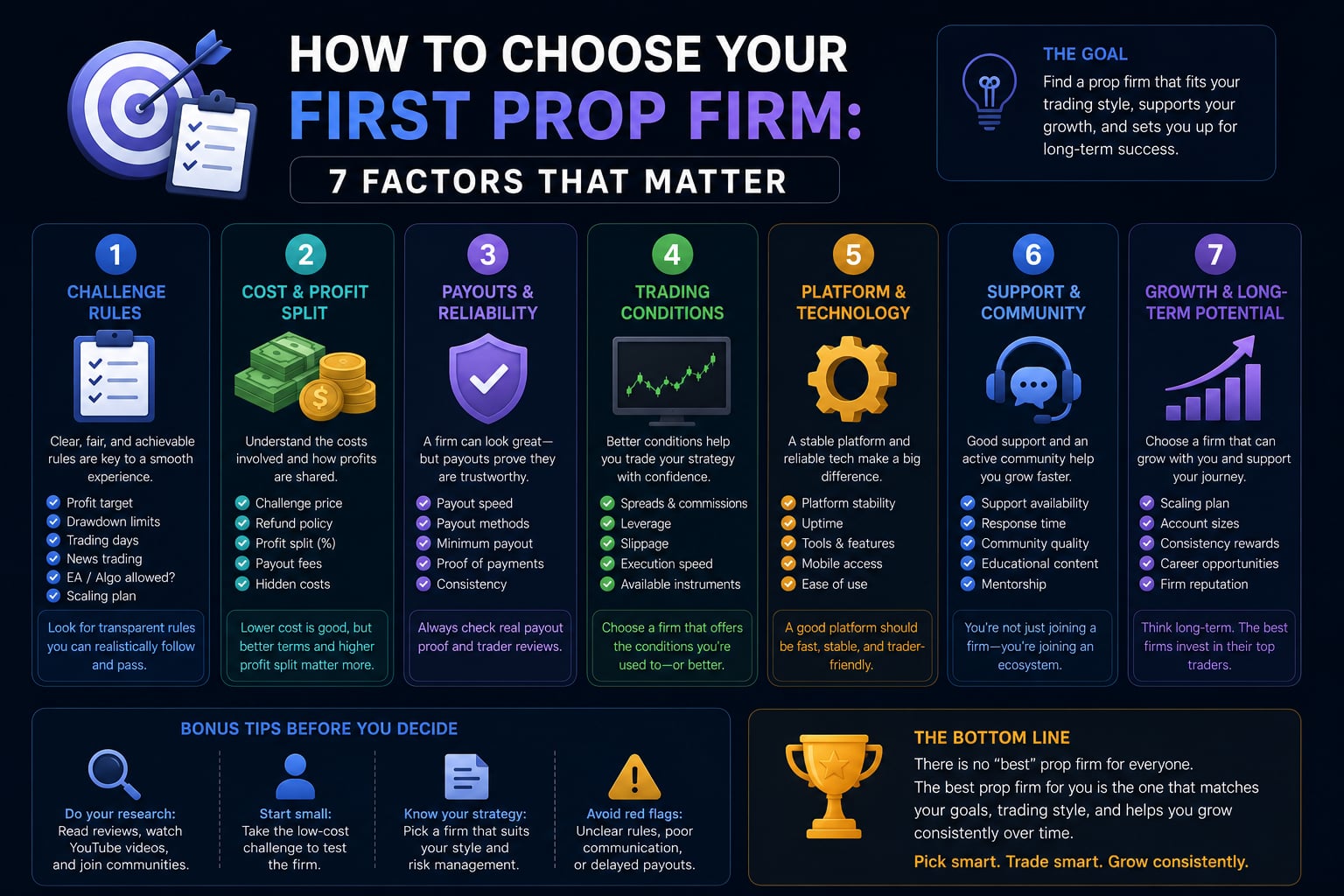
This guide walks through the seven factors that actually decide whether a firm is worth your money, roughly in the order they should influence your decision. Some of these you can check in five minutes. Others take real digging.
1. Payout reliability — check this before anything else
This is the one factor that makes every other factor irrelevant if it fails. A firm with a generous 90% split and a lenient drawdown rule is worthless if it doesn't actually pay out. And unfortunately this happens more than the industry likes to admit — firms that process payouts smoothly for months, build a reputation, then start delaying or denying payouts once they've accumulated enough funded traders.
There's no perfect way to verify this in advance, but there are decent proxies. Look for recent payout proof — not from six months ago, from the last few weeks. Search the firm's name alongside "payout" or "delayed" in trading communities and see what comes up. A firm with zero complaints is either genuinely reliable or too new to have generated any, and it's worth knowing which. Age matters here more than almost anywhere else: a firm that's been paying out consistently for two or three years has a track record. A firm that launched four months ago with an aggressive marketing budget does not, no matter how good its numbers look.
2. Drawdown rules that actually match how you trade
This one gets skipped constantly because traders assume "8% overall drawdown" means the same thing everywhere. It doesn't. Static drawdown and trailing drawdown produce completely different risk profiles on paper-identical numbers, and daily drawdown calculated on balance versus on equity can be the difference between a comfortable session and a terminated account.
If you're a swing trader who holds positions overnight or through short-term volatility, trailing drawdown calculated on equity is going to hurt you — a floating profit that later reverses can shrink your buffer even though you never realized that profit. Static drawdown, calculated on balance, gives you room to breathe. If you're a tight-stop intraday trader who closes everything daily, the difference matters less, and you can often get a better profit split by accepting the stricter trailing structure.
The mistake is picking a firm because the headline number looks generous, without checking which type of drawdown sits behind it. Read the actual rules document, not the summary. This is a five-minute check that prevents a genuinely common way to lose a challenge fee for reasons that have nothing to do with trading skill.
3. Restrictions that fit your actual strategy, not a generic one
Every firm restricts something — news trading, weekend holding, EAs, hedging, minimum or maximum lot sizes. The specific combination varies a lot, and this is where a strategy that works perfectly at one firm gets an account terminated at another.
If you trade around high-impact news releases, you need to specifically check the buffer window (some firms ban trading 2 minutes around NFP, others ban 15 minutes, some ban the entire day). If you run any kind of automated system, check whether the firm allows EAs at all, and if so, whether there are restrictions on tick scalping or HFT-style execution. If your strategy depends on holding through the weekend — carrying a swing position into Monday's gap, for example — a firm with a strict weekend-closure rule will simply force you out of positions you'd otherwise want to keep.
None of this is really about finding the most permissive firm. It's about finding the firm whose restrictions happen to line up with what you were already going to do anyway.
4. Profit split and how it changes with scaling
Most firms advertise a headline split — 80/20, 90/10 — but the number that actually matters is what happens after a few months of consistent performance. Some firms hold the split flat regardless of results. Others improve it meaningfully as traders scale, going from 80% at the entry level to 90% or higher after a few consecutive profitable scaling periods, alongside account size doubling every few months of qualifying performance.
If you're planning to stick with a single firm for a year or more (which is the realistic timeline for meaningful account scaling), the growth curve of both split and account size matters more than the entry-level number. A firm offering 90% from day one but capping scaling at $200k may be worth less over time than one starting at 80% but scaling to $2 million with an improved split along the way.
5. Challenge cost relative to account size and rules
Cheapest isn't automatically best, and this is worth saying directly because a lot of comparison content treats price as the deciding factor. A $49 challenge for a $10k account and a $500 challenge for a $100k account aren't really comparable on price alone — what matters is cost per dollar of eventual capital access, combined with how achievable the rules actually are.
A firm with a slightly higher fee but an unlimited time window, a static drawdown, and a realistic consistency rule is often better value than a firm with a rock-bottom fee and rules that make the pass rate genuinely low. Since most traders who fail a challenge end up paying for at least one more attempt, the real cost of a "cheap" challenge with harsh rules can end up higher than a firm that costs more upfront but gives you a realistic shot at passing on the first try.
6. Platform and broker execution quality
This factor gets less attention than it deserves, mostly because it doesn't show up until you're actually trading. Slippage on entries, requotes during news, spread widening at rollover — all of this affects your real results independent of your strategy, and it varies noticeably between the platforms different firms use. MT4, MT5, cTrader and proprietary platforms all behave differently, and the underlying liquidity provider matters as much as the platform itself.
If a firm offers a free demo or trial period, use it specifically to check execution quality on the pairs and timeframes you actually trade, not just to confirm the interface looks fine. A firm with generous rules and unreliable execution can still cost you a challenge.
7. How long the firm has actually been operating
Longevity is a rough proxy for a lot of things you can't check directly — financial stability, whether the business model is sustainable, whether support responds when something goes wrong. New firms aren't automatically bad, and some of the better-run operations in the space are relatively young. But a firm with three years of continuous operation has survived multiple market cycles and a lot of payout cycles without collapsing, which tells you something that marketing copy can't.
Common mistakes when choosing a first firm
Picking the firm with the biggest advertised account size without checking whether the rules make it realistically reachable
Assuming similar percentage numbers (drawdown, split) mean similar actual risk across firms
Ignoring payout reviews because the firm's own page emphasizes "instant payouts"
Choosing a challenge format that doesn't match trading style — for example, an intraday scalper paying for a two-step 60-day evaluation built for swing traders
Not reading the actual rules document before paying, relying only on the sales page summary
Chasing the lowest fee without checking pass rate difficulty behind it
Quick checklist before you pay
Recent payout proof and community sentiment checked, not just the firm's own claims
Drawdown type identified — static or trailing, balance-based or equity-based
Restrictions (news, weekend, EA) confirmed against your actual strategy
Profit split and scaling trajectory reviewed beyond the entry-level number
Challenge fee weighed against realistic pass difficulty, not just price
Platform and execution quality tested on a demo if available
Firm's operating history checked — how long it's been paying traders consistently
None of these seven factors matters in isolation. A firm can look excellent on split and scaling and still be a poor choice if payout reliability is shaky, or vice versa. The point of going through all seven before paying a fee is simple: it's a lot cheaper to spend an evening reading rules and reviews than to find out the hard way, after the money's already gone.
About Marina G.
Professional content writer specializing in prop trading and financial markets.
Related Articles
More insights from our prop trading experts