
One-step vs two-step evaluation: which is harder
"Which is easier, one-step or two-step?" gets asked in every prop trading forum, usually by someone comparing two challenges side by side and trying to decide where to spend their fee. The honest answer is that neither format is universally easier — they trade difficulty in different directions, and which one is actually harder depends heavily on what kind of trader is asking. A one-step challenge with a single 10% target and tight drawdown can be brutal for someone who trades in bursts. A two-step challenge with two lower targets stretched across 90 days can be just as brutal for someone who trades occasionally and needs the account to stay open long enough to hit both phases.
This article breaks down what actually differs between the two formats, then walks through how the difficulty shifts depending on trading style, because that's really the question underneath "which is harder."
What actually differs between the formats
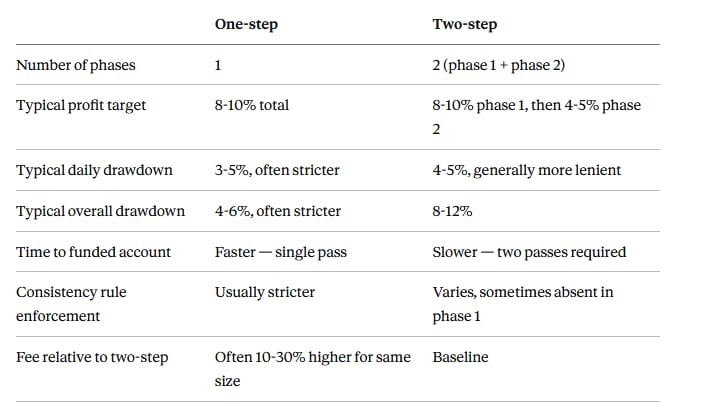
The pattern across almost every firm offering both formats is the same: one-step challenges compress the evaluation into a single pass, but they claw the difficulty back through tighter drawdown. It's not that one-step firms are being generous by skipping a phase — they're pricing the shortcut in risk terms instead of time terms.
Two-step: difficulty spread across time and consistency
The classic two-step format asks for more total profit across both phases combined (typically 12-15% total versus 8-10% for one-step), but spreads that requirement across two separate evaluations, each with its own time window and its own chance to reset if something goes wrong. Phase 1 exists to prove the trader can generate profit at all. Phase 2, with a lower target, exists mainly to prove phase 1 wasn't luck.
The real difficulty in two-step isn't the math — it's the duration. Traditional two-step challenges ran 30 days for phase 1 and 60 for phase 2, and a lot of traders who passed phase 1 comfortably still failed phase 2, not because the target was harder, but because trading the same strategy for two more months introduced more opportunities for a bad week, a distracted session, or a rule violation nobody was watching for on day 45. Unlimited-time two-step challenges have reduced this pressure somewhat, but they've introduced a different problem: without a deadline, some traders drift, trade less disciplined, and take longer to pass simply because there's no urgency forcing consistency.
Drawdown in two-step formats tends to be looser — 8-12% overall is standard — which gives more room to recover from a losing stretch. That looseness is really the trade-off for having to pass twice.
One-step: difficulty compressed into tighter risk
One-step evaluations ask for one target, typically similar to a two-step's phase 1 number, and then it's over — pass and you're funded. The appeal is obvious: faster access to a funded account, one fee, one pass, done. But the drawdown numbers on most one-step challenges are noticeably tighter than what you'd see in a two-step's phase 1, often 3-5% daily and 4-6% overall instead of 4-5% and 8-12%.
That tightness is the actual price of skipping a phase. A trader with the same strategy and the same win rate will, on average, find a one-step evaluation less forgiving of a single bad trade, because there's less overall drawdown buffer to absorb it and no second phase to fall back on if something goes wrong early. Some firms compensate with a lower profit target, but plenty don't — you're still expected to generate 8-10% profit, just with roughly half the room for error along the way.
For a trader with a genuinely low-variance strategy — tight stops, high win rate, consistent position sizing — one-step can actually be the easier path, because the strategy rarely tests the tighter drawdown limit anyway. For anyone with more variance in their results, even variance that nets out positive over time, one-step is where that variance gets punished hardest.
How difficulty shifts by trading style
For scalpers and high-frequency intraday traders, one-step often plays to their strengths. High trade frequency with tight, consistent stop-losses rarely produces the kind of single large loss that trips a tight drawdown limit, and the faster path to funding matters more to a style that depends on volume of opportunities rather than patience. The consistency rule enforcement common in one-step formats is also less of an obstacle here — frequent smaller wins naturally distribute profit across many days rather than concentrating it in one.
For swing traders, the calculation flips. Swing positions held for days carry larger unrealized swings by nature, and a tight overall drawdown — especially if it's calculated on equity rather than balance — turns ordinary position management into a minefield. A swing trader who's comfortable holding through a 3% adverse move needs an overall drawdown large enough to absorb that, which points toward two-step's looser 8-12% range rather than one-step's 4-6%. The extended timeline of two-step also suits swing trading naturally, since the strategy itself operates on a slower rhythm anyway.
For news traders, the deciding factor usually isn't the phase structure at all — it's whether the firm allows news trading in the first place, and how tight the buffer window is around releases. That said, news trading tends to produce sharp, sudden P&L swings, which makes the tighter drawdown of one-step formats a real risk. A missed calculation on position size ahead of an NFP release can do more damage inside a 4% overall limit than an 8% one. Two-step generally gives news traders more room to be wrong about volatility once in a while without ending the evaluation.
For complete beginners still refining a strategy, two-step is almost always the more forgiving starting point — not because the total requirement is lower (it's usually higher), but because the looser drawdown and the phase structure itself allow room to learn without a single mistake ending everything.
Where the "which is harder" question breaks down
The honest answer is that difficulty in these formats isn't really about the number of phases — it's about how much room for error exists per dollar of profit target. Two-step trades a longer timeline and more total profit required for a bigger risk cushion at each step. One-step trades speed and a single pass for a much thinner margin of safety.
A disciplined trader with low variance in results and a fast trading rhythm will generally find one-step easier in practice, even though the drawdown numbers look scarier on paper. A trader who needs room to be occasionally wrong — because the strategy holds positions longer, trades less frequently, or is still being refined — will usually find two-step easier, even though it demands more total profit and more patience.
The practical takeaway
Don't pick a format based on which one sounds faster or which one has the lower headline profit target. Look at your own results: how often does a single trade produce a loss larger than 2-3% of the account, and how much does your strategy depend on holding positions through short-term adverse moves. If the answer to both is "rarely," a one-step challenge is probably the faster and genuinely easier route to a funded account. If either answer leans toward "sometimes" or "often," the extra breathing room in a two-step's drawdown rules is very likely worth the additional time it takes to clear both phases.
About Marina G.
Professional content writer specializing in prop trading and financial markets.
Related Articles
More insights from our prop trading experts